Opinion: How We’ll Discover to Cope with Coronavirus
Wonder Land: The coronavirus lockdown model will collapse below its own weight, weakened by politics, confusion about the infection itself, and the fundamentals of human nature. Images: AFP/Getty Images Composite: Mark Kelly
E4
Opinion: Coronavirus, Pandemics and the Issue of Preparedness
Marvel Land: Cosmetic Surgeon General Jerome Adams was ideal: This virus is our Pearl Harbor, a disastrous failure. Images: AFP/Getty Images Composite: Mark Kelly
E3
Opinion: The Next Coronavirus War
Wonder Land: While Republicans caution versus an irreversible federal government growth, Democrats including Nancy Pelosi, Chuck Schumer and Alexandria Ocasio-Cortez see this as a big progressive moment. Images: CDC/Planet Pix/Getty Images Composite: Mark Kelly
A brand-new virus had quickly spread across the globe and Tuomey Health care System in South Carolina could not get more protective masks for its medical facility employees. Tuomey later on stockpiled protective gear, however over the years didn’t renew some ended products.
The U.S. Navy will open a second investigation into the coronavirus break out aboard the USS Theodore Roosevelt, a top authorities said Wednesday, postponing action on a suggestion that the aircraft carrier’s leader, Capt. Brett Crozier, be renewed to task.
Capt. Crozier was eliminated from his post April 2 after writing and distributing a memo requiring a more aggressive Navy response to the coronavirus outbreak. Following a first investigation, the Navy recommended last week that Capt. Crozier be reinstated.
Doctors in Italy and the U.K. have raised the alarm over a small however growing number of kids showing signs of a rare blood-vessel illness that might be linked to Covid-19
In both nations, medical professionals have alerted their associates to look out for symptoms associated with Kawasaki disease, an inflammatory condition that usually impacts young kids.
LONDON– U.K. Prime Minister Boris Johnson and his fiancée Carrie Symonds announced the birth of a baby boy, topping a troubled month for the British leader who is just back at work after being hospitalized by the new coronavirus.
A spokesperson for the couple stated Wednesday the couple were “delighted” after the birth of a healthy child at a London hospital, including that both mom and kid were doing extremely well. Mr. Johnson will take a brief period of paternity leave later on in the year however was back in Downing Street by Wednesday …
WASHINGTON– Federal Reserve Chairman Jerome Powell delivered an uncharacteristically blunt call on Wednesday for Congress and the White House to invest more money to prevent deeper financial damage from the coronavirus pandemic.
Congress and President Trump have supplied more than $2.6 trillion in several financial assistance steps over the last 2 months, and Mr. Powell admired those efforts as suitable.
SUBMIT This Monday, Dec. 4, 2017, photo reveals the Pfizer business logo design at the business’s headquarters in New york city. The pharmaceutical business has partnered with Germany-based BioNTech to create a COVID-19 vaccine that might be ready for emergency use as early as fall 2020.
FILE This Monday, Dec. 4, 2017, picture shows the Pfizer company logo at the business’s head office in New york city. The pharmaceutical company has partnered with Germany-based BioNTech to create a COVID-19 vaccine
FILE This Monday, Dec. 4, 2017, photo shows the Pfizer business logo at the company’s head office in New York. The pharmaceutical business has partnered with Germany-based BioNTech to develop a COVID-19 vaccine that might be ready for emergency use as early as fall 2020.
FILE This Monday, Dec. 4, 2017, picture shows the Pfizer company logo at the business’s headquarters in New york city. The pharmaceutical business has actually partnered with Germany-based BioNTech to produce a COVID-19 vaccine
American pharmaceutical corporation Pfizer says it could have an emergency COVID-19 vaccine all set as early as this fall and a larger present by year’s end, according to a report in the Wall Street Journal Oxford University states it’s likewise on track to have a coronavirus vaccine readily available by September.
The New York-based Pfizer partnered with German business BioNTech and sped up the typical timeline for creating a vaccine to eliminate a virus that has put the world to a near stop.
Pfizer and BioNTech began checking on people in Germany on April 23 with 12 people being administered the vaccine, BNT162, in a Phase 1/2 medical study, according to a joint declaration As testing continues in Germany, approximately 200 volunteers age 18 to 55 will be offered a range of dosages to determine the optimal dose for upcoming research studies.
Evaluating in the United Sates will start as soon as the business have approval from the Fda; that might start within a week, according to the WSJ Journal.
The business expect to have data on the trials by late June.
” The two companies prepare to collectively conduct scientific trials for the COVID-19 vaccine candidates at first in Europe and the U.S., throughout numerous research study websites,” Pfizer states in its first quarter report published online Tuesday. “The companies approximate that there is potential to supply millions of vaccine doses by the end of 2020, subject to technical success of the development program and approval by regulatory authorities, and the potential to rapidly scale up the capacity to produce numerous millions of dosages in 2021.”
Oxford University has had the ability to speed up its procedure by using technology its lab established in previous vaccine projects. “Well personally, I have a high degree of self-confidence about this vaccine, since it’s innovation that I have actually utilized prior to,” stated professor of vaccinology Sarah Gilbert to CBS News. Oxford is likewise currently in the phase of providing injections to hundreds of healthy volunteers in hopes of informing not just if the vaccine is safe however if it works.
Oxford researchers created the new vaccine by inserting genes for a spikey protein that studs the outer surface of the brand-new coronavirus into another, harmless virus. The idea: The immune system will spot the foreign protein and make antibodies to combat it, primed to respond rapidly if the individual becomes exposed to COVID-19
The timelines for both vaccines are positive considering that inoculations normally take years to establish. Professionals have warned that even if early studies go well, it will be at least a year prior to any are offered for widespread usage.
This is among dozens of vaccines being checked in a race to find a magic bullet to stop the spread of the coronavirus. On April 20, the World Health Company recorded 5 vaccines in medical examination and 71 vaccines in preclinical assessment around the world.
The Associated Press contributed to this report.
MORE CORONAVIRUS PROTECTION:
Sign up for ‘The Daily’ newsletter for the latest on coronavirus here
The European Reserve Bank‘s (ECB) Governing Council will convene in a virtual conference Thursday to go over whether the procedures taken, for now, suffice to weather what might be the worst recession considering that World War II.
The odds are high that ECB President Christine Lagarde will stress the reserve bank’s ability to do more if needed in order to avoid fragmentation in the euro area and a tightening of financial conditions.
” There are 2 goals the ECB will concentrate on at that stage. First, to make sure accommodative monetary conditions and preventing tensions in the financial system,” stated Dirk Schumacher, an ECB watcher with Natixis, in a research note.
” Second to develop fiscal space for governments to eliminate the cyclical repercussions of the pandemic.”
To handle the second goal, the ECB is trying to check spread expansions in between the core and so-called peripheral countries such as Italy, Spain, Portugal and Greece. A spread describes the distinction in the yields in between nations, which can highlight how afraid investors have actually become on owning European financial obligation.
” Undoubtedly the ECB would have hoped to be safe for a lot longer after introducing its PEPP bazooka on March 18, but the truth is that the financial and political situation remains extremely tough with the central bank still perceived as the only reputable bulwark against an unwarranted tightening up of monetary conditions,” stated Frederik Ducrozet of Pictet Wealth Management in a note.
” It will be a chance to take stock, as the very first difficult information for Q1 (the very first quarter) begin coming in, painting a clearer photo of the preliminary damage to the economy,” stated Anatoli Annenkov with Societe Generale in a note to clients.
” Unless there is another bond market scare we would expect the ECB to stay on hold for now while fine-tuning collateral and supervisory rules to support credit flows.”
The ECB’s April lending survey reveals that credit requirements for loans to enterprises and families have actually tightened up in the very first quarter, while need for loans and drawing of line of credit have actually risen.
” At least, the ECB will be under pressure to indicate the possibility of an increase in the 750 billion euro envelop faster rather than later,” stated Ducrozet.
Whether the PEPP will be huge enough is currently being questioned by some economic experts. For now the ECB is anticipated to hold stable and evaluate the existing steps.
European markets open flat, while Wall Street appeared poised for day of positive trading.
Image
Laboratory specialists loading vials of remdesivir, a speculative antiviral drug to treat the coronavirus, at a Gilead Sciences facility last month in California.Credit …Gilead Sciences, by means of Reuters
Asian markets climb after Wall Street’s rally.
Asian markets rose on Thursday, carried by optimism overnight on Wall Street that a brand-new drug could help to treat Covid-19 The belief was more mixed as Europe’s biggest financial capitals began the trading day.
Futures trading pointed to a positive open for Wall Street on Thursday.
In London, the FTSE 100 was flat in early trading. Germany’s DAX fell by 0.1 percent while France’s CAC 40 was up 0.2 percent.
In the Asia-Pacific area, investors were more bullish ahead of the long weekend. In Tokyo, the Nikkei 225 leapt by 2.1 percent. China’s Shanghai Composite acquired 1.3 percent, while in Shenzhen stocks were up 1.9 percent. South Korea’s Kospi increased 0.7 percent. Hong Kong’s Hang Seng is closed for a vacation.
The rally in Asia was a continuation of a strong day on Wall Street on Wednesday, where the S&P 500 acquired 2.7 percent, increased by news from drugmaker Gilead Science that it had positive arise from a trial for an antiviral drug called remdesivir. It is being evaluated as a possible treatment for Covid-19
This news was also a benefit to Chinese drugmakers that make a few of the components in Gilead’s brand-new drug.
Chinese markets rallied after data about the services sector for the month of April was firmer than expected. Other data released still highlighted the gap in need for Chinese-made items overseas.
More comprehensive favorable belief was on display in products markets, too, as the price of oil continued a rally following news from Norway, a significant oil manufacturer, that it would restrict production, something that will lift drooping rates. The rate of the U.S. standard, the West Texas Intermediate, leapt 13 percent to $1706, while Brent, the international benchmark, rose nearly 7 percent to $2597 a barrel.
The price of gold also rallied.
The yield on United States 10- year treasuries fell to 0.61 percent.
Millions more unemployed claims are anticipated to be reported on Thursday.
The variety of brand-new unemployment claims weekly has actually been decreasing. As the American economy continues to stagger under the weight of the coronavirus pandemic, that is little comfort.
Another grim numeration is anticipated Thursday at 8: 30 a.m., when the Labor Department reports the tally of claims for last week. The agreement projection mentioned by Bloomberg is 3.5 million, though some economists see a number better to 4 million.
That would bring the six-week overall to the cusp of 30 million unemployed claims, despite trillions in stimulus costs and a rush to resume shuttered companies in some states.
Numerous state firms still find themselves overwhelmed by the flood of claims, leaving maybe millions with dwindling resources to pay the rent or put food on the table.
If anything, according to lots of economic experts, the task losses might be far worse than government figures show. A study by the Economic Policy Institute found that approximately 50 percent more individuals than counted as filing claims in a recent four-week duration may have received advantages but were stymied in using or didn’t even try because they found the process too overwhelming.
” The issue is even bigger than the information recommend,” stated Elise Gould, a senior economic expert with the institute, a left-leaning research group. “We’re undercounting the financial pain.”
Norway to cut oil production as demand craters.
Norway will cut oil production by 250,000 barrels a day, or about 13 percent, in June and by 134,000 barrels a day for the rest of 2020, the nation’s Ministry of Petroleum and Energy stated. The relocation “will contribute to a faster stabilization of the oil market” than leaving matters to market forces, the ministry said in a statement.
Need for oil has actually collapsed as the coronavirus pandemic has caused the grounding of most of the world’s industrial aircraft, in addition to the sharp curtailment of road traffic. The resulting oversupply of oil threatens to outstrip storage centers and is forcing oil companies around the globe to throttle back production.
Norway’s cuts will add to the 9.7 million barrels a day in cuts that the Organization of the Petroleum Exporting Countries, Russia and other nations accepted on April12 Tina Bru, the Norwegian energy minister, stated that Norway was acting “on an independent basis and with Norwegian interests at heart.”
The relocation, however, is likely to spark optimism amongst traders that oil-producing nations are taking more coordinated actions to deal with the glut. The price of Brent crude, the global criteria, increased by practically 10 percent Thursday to $2475 a barrel, however it remains down more than 60 percent because the beginning of the year.
The Norwegian government said that the output trims would be “relatively dispersed” among oil fields and operators which the start-ups of a number of fields would be delayed till 2021.
Wall Street gets rid of bad economic news as data on antiviral drug lifts hopes.
Stocks rallied on Wednesday, boosted by indications that a drug being evaluated as a possible treatment for Covid-19 could be showing development, and as financiers pinned their hopes on the progressive reopening of the world’s significant economies.
The S&P 500 gained almost 3 percent, while shares in Europe were also dramatically higher.
The rally came in spite of information that revealed the U.S. economy diminished in the first quarter of the year by the most considering that2008 Incomes reports from Volkswagen, Samsung, Airbus, Boeing and other huge businesses were likewise grim.
However financiers have been getting rid of bad news on the economy for weeks as they focus on progress on efforts to include the coronavirus pandemic. A steady climb has actually raised the S&P 500 by more than 31 percent since its March 23 low. With nearly half that gain being available in April, the month is on track to be the best for stocks given that 1974, according to information from Howard Silverblatt, senior index analyst for S&P Dow Jones Indices.
The trading on Wednesday had all the hallmarks of a rally fueled by hopes of a go back to typical, with shares of airlines and cruise operators– both industries that are dependent on the end of constraints and the return of travelers– amongst the best-performing stocks in the S&P500 Oil manufacturers likewise rallied as the rate of petroleum rose.
A rally in the stocks of big innovation business, which have an outsize effect on the total market, also assisted. Alphabet rose nearly 9 percent the day after it reported quarterly results that were much better than expected, and Facebook was more than 6 percent higher.
Prior to trading started Wednesday, the drugmaker GileadSciences stated it was “knowledgeable about favorable data” emerging from a trial of its antiviral drug being conducted by the National Institute of Allergic Reaction and Transmittable Diseases. The drug, remdesivir, is being tested as a treatment for Covid-19, the illness brought on by the coronavirus.
After Tesla’s profit plunges, Elon Musk calls California’s lockdown ‘fascist.’
Tesla on Wednesday reported a high drop in net income in the very first quarter compared with the previous quarter, as the coronavirus pandemic interfered with the electric-car maker’s operations in the United States and China, its two largest markets.
Elon Musk, the company’s chief executive, said the business would continue to deal with difficulties as long as it was forced to keep its plant in Fremont, Calif., closed under the state’s stay-at-home order.
” We are a bit concerned about when we will be able to resume production in the Bay Location,” Mr. Musk said on a teleconference with reporters.
He went on to say the stay-at-home order was “fascist” and totaled up to “forcibly putting behind bars individuals in their houses versus all their constitutional rights.”
” They’re breaking people’s liberties in ways that are incorrect and are not why individuals came here or constructed this nation,” he said.
California enforced the lockdown in March and needed all nonessential organisations to close. But Tesla told workers at the Fremont plant to report to work unless they were sick, or to take getaway days if they stayed at house. The regional sheriff’s workplace forced the business to obey the state order and close the plant.
Tesla’s plant in Shanghai has actually resumed production.
On Wednesday, the business reported $16 million in net income for the first three months of the year, a drop of 85 percent compared to the 4th quarter. Earnings in the quarter totaled $6 billion, a 20 percent drop from the previous quarter.
Tesla decreased to use guidance for the second quarter due to the fact that of the uncertain financial and public health outlook. The company’s shares surged 10 percent after the marketplace closed.
SoftBank informs investors to brace for bigger-than-expected loss on WeWork.
A little over two weeks earlier, SoftBank alerted financiers to be gotten ready for its yearly revenues outcomes to be a blood bath, as the coronavirus cratered the value of its financial investments in risky tech start-ups. On Thursday, it stated the damage could be even worse than anticipated, including an additional $1.4 billion to its expected losses from the degeneration of its WeWork holdings.
The brand-new warning brings the total of Softbank’s anticipated bottom line in the ending in March to 900 billion yen, or $8.4 billion, adding another asterisk to the track record of the business’s president, Masayoshi Son, and his objective of ending up being an epoch-making tech investor.
Mr. Kid has actually utilized his enormous impact to place SoftBank as the world’s largest tech investor, deploying his $100 billion Vision Fund to catapult appealing and sometimes dangerous young tech business, like Uber and the hotel operator Oyo, from obscurity to popularity and fortune.
The freshly reported figures have been driven down “mostly” by investments made beyond the Vision Fund, including in WeWork, the co-working start-up, SoftBank said in a statement. It stated that losses at the business were projected to be in excess of 1 trillion yen.
Earlier this month, the business revealed that it expected to take a $167 billion write-down on its financial investments in the Vision Fund, a loss that would be offset by earnings from the conglomerate’s other services, including its successful Japanese telecom business.
The fund’s portfolio, which is heavy on financial investments in ride-sharing and property business, has been hit hard by dropping demand for its star companies’ services in the middle of the coronavirus pandemic.
Softbank’s financial investment in WeWork has metamorphosed from eagle to albatross over the previous year, as WeWork’s promising prepare for an initial public offering imploded in the middle of accusations of mismanagement and self-dealing.
Here are the other big companies that reported earnings today.
The deluge of first-quarter reports this week is giving financiers a comprehensive take a look at how the start of the coronavirus crisis affected companies. Of course, second-quarter profits this year may well be much more grim.
Facebook warned Wall Street that it might deal with magnifying difficulties in its advertising organisation as the spread of the coronavirus ripples through the international economy, although the falloff in spending has stabilized. The business’s revenue in the first quarter increased 18 percent to $1774 billion from a year earlier, while revenue more than doubled to $4.9 billion, surpassing Wall Street estimates. A year previously, Facebook had taken a $3 billion charge to spend for a privacy settlement with the Federal Trade Commission.
Microsoft reported strong growth in sales and profits for the quarter ended in March, stating that the coronavirus outbreak had “very little net effect” on its financial performance. Income rose 15 percent to $35 billion, compared with the analysts’ consensus projection of $3366 billion. Its operating earnings per share increased 23 percent to $1.40 a share in the quarter. That was well above the average estimate of Wall Street analysts of $1.26 a share, as compiled by Refinitiv, a research firm.
Royal Dutch Shell, Europe’s biggest oil company, said on Thursday that it would cut its dividend for the very first time considering that World War II as the company reported a loss of $24 million for the quarter compared to $6 billion in profits in the period a year earlier. The business said it was reducing its dividend, which pension funds and other investors rely on for earnings, by about two-thirds to 16 cents a share, pointing out the threat of an extended period of weak oil rates because of the results of the coronavirus pandemic.
Capture up: Here’s what else is occurring.
FedEx stated on Wednesday that it would not take federal funds earmarked to pay workers under the CARES Act, one day after UPS revealed the very same. Legislators had actually set aside $25 billion in grants for traveler airline companies and $4 billion for freight carriers to pay employees, though the Treasury Department later on classified a part of the funds for airline companies as a loan.
Reporting was contributed by Stanley Reed, Ben Dooley, Nelson D. Schwartz, Alexandra Stevenson, Niraj Chokshi, Neal E. Boudette, Steve Lohr and Mike Isaac.
Oil giant Royal Dutch Shell on Thursday cut its dividend to shareholders for the first time since World War II, following a dramatic slide in oil prices amid the coronavirus crisis.
The board at Shell said it had decided to reduce the oil major’s first-quarter dividend to $0.16 per share, down from $0.47 at the end of 2019. That’s a reduction of 66%.
“Shareholder returns are a fundamental part of Shell’s financial framework,” Chad Holliday, chair of the board of Royal Dutch Shell, said in a statement.
“However, given the risk of a prolonged period of economic uncertainty, weaker commodity prices, higher volatility and uncertain demand outlook, the Board believes that maintaining the current level of shareholder distributions is not prudent.”
Shell also reported that net income attributable to shareholders on a current cost of supplies (CCS) basis and excluding identified items, which is used as a proxy for net profit, came in at $2.9 billion for the first quarter of 2020. That compared with $5.3 billion in the first quarter of 2019, reflecting a year-on-year fall of 46%.
Analysts polled by Refinitiv had expected first-quarter net profit to come in at $2.5 billion for the quarter.
Shares of Shell dropped to the bottom of the European benchmark during early morning deals, down more than 7%.
Last week, Norway’s Equinor became the first oil major to cut its dividend this earnings season. It raised concern that other energy giants may follow suit, although BP, which reported Tuesday, maintained its dividend.
Investors will now be watching U.S. oil majors Chevron and Exxon Mobil, which are both due to release results Friday.
Tamas Varga, senior analyst at PVM Oil Associates, told CNBC via email that Shell had taken the “same approach” as Norway’s Equinor by cutting its quarterly dividend by roughly two-thirds.
“As demand destruction bites, cash is king.” Varga said, adding that suspending share buybacks, slashing capital expenditure and reducing dividends were “becoming the norm.”
‘Extremely challenging’ conditions
Shell CEO Ben van Beurden described energy market conditions through the first three months of the year as “extremely challenging.”
“Given the continued deterioration in the macroeconomic outlook and the significant mid and long-term uncertainty, we are taking further prudent steps to bolster our resilience, underpin the strength of our balance sheet and support the long-term value creation of Shell,” he added.
An offshore drilling and production platform.
Gary Tramontina | Corbis | Getty Images
Alongside the cut to its dividend, Shell announced it would not continue with the next tranche of its share buyback program. Since the launch of the program, the oil major said it had bought back almost $16 billion in shares for cancellation.
“On the face of it, the dividend cut and cancellation of share buybacks may be seen by some shareholders as a negative move in the short term,” David Barclay, senior investment manager at Brewin Dolphin, said in an email.
“However, looking further ahead it could well prove to be the right step as Shell looks to strengthen its financial position and cut costs during a very difficult time.”
The energy giant’s results come shortly after a historic plunge in oil prices.
The May contract of U.S. West Texas Intermediate plunged below zero to trade in negative territory for the first time in history last week. Trading volume was thin given it was the day before the contract’s expiration date, but, nonetheless, the move lower was extraordinary.
WTI futures had fetched more than $60 a barrel at the start of the year. A dramatic fall-off in demand as a result of the coronavirus outbreak has sent oil prices tumbling.
On Thursday, the June contract of WTI traded at $16.55 per barrel, almost 10% higher for the session, while international benchmark Brent crude stood at $23.81, up around 5%.
London (CNN Business)Global energy use has been dealt such a huge blow by the coronavirus pandemic that it’s like wiping out demand from all of India, a country of 1.3 billion people and the world’s third biggest consumer.
That’s according to the Internation… Read More
China’smanufacturing sector has been hit by slowing export demand due to the economic impact from the global coronavirus pandemic even as factories in the world’s second-largest economy resumed production, two sets of April data released on Thursday showed.
Results of a private survey, the Caixin/Markit manufacturing Purchasing Manager’s Index (PMI), for April was 49.4 — in contractionary territory. Analysts polled by Reuters had expected the Caixin/Markit manufacturing PMI to come in at 50.3, compared with 50.1 in March.
Meanwhile, China’s National Bureau of Statistics said manufacturing activity in the country expanded slightly, reporting official manufacturing PMI of 50.8 for the month of April, as compared to 52.0 in March.Analysts polled by Reuters had expected official manufacturing PMI to come in at 51.0 in April.
PMI readings above 50 indicate expansion, while those below that level signal contraction.
The Caixin/Markit survey features a bigger mix of small- and medium-sized firms. In comparison, the official PMI survey typically polls a large proportion of big businesses and state-owned companies.
In February, the official manufacturing PMI hit a record low of 35.7 and the Caixin reading also fell to a record low of 40.3 as China was hit by the coronavirus outbreak that first emerged from the city of Wuhan. Large-scale lockdowns were implemented from late January to slow the spread of the disease officially known as Covid-19, sending the world’s second-largest economy to a standstill.
In the first quarter of 2020, China’s GDP contracted by 6.8% from a year ago — the first decline since at least 1992, when official quarterly GDP records started.
Lockdowns in China have started to lift with people going back to work as the number of daily new Covid-19 cases fall. But demand for Chinese products is now expected to slump after the coronavirus spread to the rest of the world, sparking concerns about a global recession.
China’s National Bureau of Statistics said in its analysis of the PMI readings that the recovery in demand was weaker than the recovery in production, according to a CNBC translation of its Mandarin language release. This was particularly true in sectors like textiles and apparel manufacturing and chemical raw materials production.
The bureau also flagged heightened uncertainties in the export market with some factories reporting canceled orders.
“The spread of the epidemic has accelerated overseas and global economic activity has contracted sharply,” it said, adding that China’s foreign trade is now facing greater challenges.
An analysis of the Caixin/IHS survey reflected similar sentiments.
“China’s economic recovery was hindered by shrinking foreign demand, despite the domestic epidemic being largely contained,” said Zhengsheng Zhong, chief economist at the CEBM Group, a subsidiary of Caixin.
The survey from Caixin/IHS showed a sharp contraction in foreign demand in April, with “the gauge for new export orders dropped back sharply to a level lower than that in February, pointing to a sharp contraction in foreign demand amid the coronavirus pandemic,” Zhong wrote in a press release.
“While manufacturing output expanded at a faster clip, export orders plunged amid sluggish demand,” he added. Meanwhile there was just “limited recovery in domestic consumption.”
Even though the work resumption rate of large firms reached over 98% as of April 25, just 77.3% of them reported operating at 80% or more of their usual capacity.
“So the nationwide utilization rates, especially those for small- and mid-sized firms, as well as those not yet resume to work, are still facing severe headwinds amid sluggish domestic and external demand,” said Bruce Pang, head of macro and strategy research at China Renaissance Securities.
Chinese authorities have rolled out measures to support the economy.
The Chinese government will also need to increase public sector spending in order to boost growth this year, said Michael Pettis, a professor of finance at Peking University.
Even before the Covid-19 outbreak, China had to shore up public spending to meet growth targets that were higher than the real underlying economic growth rate, so there would be more of that expenditure this year due to the fallout from the pandemic, Pettis told CNBC’s “Street Signs.”
“Exports are going to be terrible, consumption is down, private investment is going to be down, so that means that the public sector needs to bear an even bigger burden, an even bigger share of growth,” said Pettis.
Bitcoin popped to fresh quarter highs Wednesday as the US Federal Reserve warned of a “medium-term” economic disaster.
The central bank decided to maintain its benchmark lending rates near zero while calling for further stimulus support from Washington.
The dovish outlook helped to send all leading assets higher, including the Wall Street index and Gold.
Bitcoin was among the biggest gainers Thursday as the Federal Reserve left benchmark lending rates near-zero and hinted at providing further stimulus if necessary.
BTCUSD Pops over $9.2K in a Surprising Pre-Halving Rally | Source: TradingView.com, Coinbase
The anti-fiat cryptocurrency popped 4.98 percent to hit its seven-week high at $9,233 and maintained those gains further into the day. Its move uphill came even as the Fed painted a gloomier “medium-term” economic outlook led by the fast-spreading Coronavirus pandemic.
More Stimulus
Chairman Jerome Powell said in a press brief Wednesday that he expects the U.S. economy to shrink further on three factors: the uncertain virus curve, loss of productive capacity caused by social distancing, and the crisis’ global dimension.
Meanwhile, the Federal Open Market Committee added that the Fed would act “forcefully, proactively and aggressively” to safeguard the U.S. economy.
“The Federal Reserve is committed to using its full range of tools to support the US economy in this challenging time,” it said at the end of its two-day meeting on Wednesday.
The central bank kept interest rates near March 15 levels – between 0 and 0.25 percent – and promised to maintain the range until it sees the U.S. economy achieve its “maximum employment and price stability goals.”
A Well-Timed Bitcoin Rally
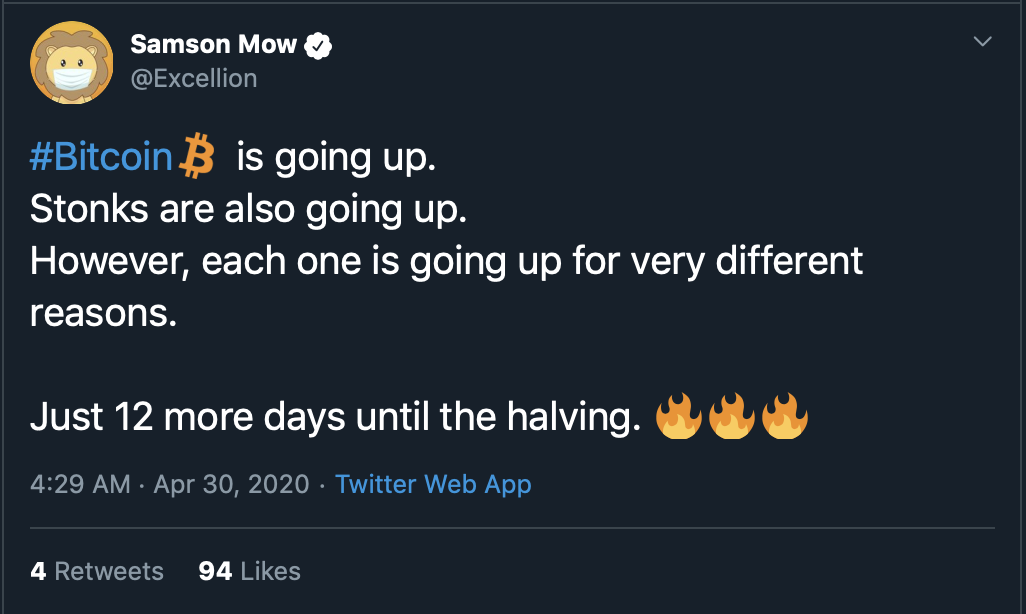
The Fed’s dovish policy helped Bitcoin, U.S. equities, and even Gold logging a wild intraday rally. But for Samson Mow, the cryptocurrency had more solid reasons to grow other than artificial inflation caused by the world’s biggest central bank.
The CSO of blockchain technology firm Blockstream said Thursday that bitcoin draw higher demand from traders ahead of its mining reward halving on May 12, 2020. The event will send the cryptocurrency’s daily production down from 1,800 BTC to 900 BTC – a complete opposite of what the Fed is doing by printing more US dollar units.
Bitcoin and U.S. equities have different bullish catalysts | Source: Samson Mow
But the act of pumping bitcoin also led to theories about the market’s liquidity. ZeroHedge’s activist journalist, who works under the pseudonym of Tyler Durden, called bitcoin’s weekly rise a “hilarious cycle” – a textbook definition of an illiquid altcoin.
“My hope is that the halving will financially destroy as many Chinese miners as possible and we can actually have a legitimate bull market instead of this pump and dump movie,” Mr. Durden wrote.
Shares in the United States and Asia have increased on hopes that an experimental drug could help treat signs of Covid-19
A leading United States infectious illness expert stated that early outcomes of a scientific trial on anti-viral treatment remdesivir were “quite good news”.
Investors are betting the drug could assist countries emerge from lockdowns aimed at curbing the outbreak.
Gilead Sciences, which is establishing the drug, saw its shares increase by more than 5.5%New york city trading.
Markets had actually already begun to increase after Gilead said preliminary signs from a remdesivir trial revealed that it assisted clients recuperate quicker.
A potential medical development like this is viewed as a crucial action towards federal governments being able to alleviate the tight limitations they have troubled the motion of people as they try to slow the spread of the infection.
Lockdowns across the world have frozen economic activity, resulted in hundreds of millions of individuals being put out of work and raised concerns of a long, deep international recession.
Shares also got a boost from a pledge by the United States reserve bank that it would continue to support the American economy versus the impact of the pandemic.
At the end of its two-day financial policy conference, the Federal Reserve left essential rate of interest near no, while Chairman Jerome Powell cautioned that the US economy would drop at an “extraordinary rate” in the current quarter.
However he likewise said development would pick up as constraints were lifted and swore that the Fed would continue to support the recovery.
Japan’s benchmark Nikkei 225 was up by 2.1%and Australia’s S&P/ ASX 200 was 2.4%higher.
That came on the back of strong gains for US stock markets. The Dow Jones Industrial Average closed 2.2%higher, the S&P 500 ended up by 2.7%and the Nasdaq gained 3.6%.
WASHINGTON– The share of Americans getting wed has actually fallen to its most affordable level on record, according to federal government figures launched Wednesday that show how economic insecurity and altering norms are eroding the institution.
The U.S. marriage rate fell 6%in 2018, with 6.5 new unions formed for every 1,000 people, according to a report by the National Center for Health Stats. That was the most affordable rate considering that the federal government began keeping data in 1867, stated Sally Curtin, a statistician at the center and lead author …
The waters overloaded bean and corn fields and developed a breeding ground for a swarm of desert locusts the size of Manhattan that fanned out and destroyed a swath of farmland throughout 8 East African countries as big as Oklahoma previously this year.
Now their offspring are threatening a historical invasion– a second wave of locusts, 20 times as large as the very first, that the U.N. warns might chew their way through 2 million square miles of pastureland, farms and gardens, around half the size of Western Europe.
New Zealand enforced one of the strictest lockdowns in the world, aiming to stamp out the new coronavirus. Australia took a different approach, embracing social-distancing restrictions but keeping more of its economy open, in an effort to suppress the pathogen.
Both strategies appear to have actually delivered similar health results: New infections have actually dropped significantly– to just a couple a day on average in New Zealand and around 10 a day in Australia. However the financial and social expenses look likely to be substantially bigger in New Zealand, …