Stanphyl Capital’s letter to traders for the month of Novemeber, 2019.
Associates and Fellow Traders:
Get The Full Warren Buffett Collection in PDF
Get all the 10-part collection on Warren Buffett in PDF. Reserve it to your desktop, learn it in your pill, or electronic mail to your colleagues

Q3 2019 hedge fund letters, conferences and extra
For November 2019 the fund was down zero.eight% internet of all charges and bills. By the use of comparability, the S&P 500 was up three.6% whereas the Russell 2000 was up four.1%. 12 months-to-date 2019 the fund is up 5.5% whereas the S&P 500 is up 27.6% and the Russell 2000 is up 22.zero%. Since inception on June 1, 2011 the fund is up 73.5% internet whereas the S&P 500 is up 179.1% and the Russell 2000 is up 115.5%. Since inception the fund has compounded at 6.7% internet yearly vs 12.eight% for the S&P 500 and 9.5% for the Russell 2000. (The S&P and Russell performances are based mostly on their “Total Returns” indices which embody reinvested dividends. The fund’s efficiency outcomes are approximate; traders will obtain actual figures from the skin administrator inside every week or two. Please observe that particular person companions’ returns will differ in accordance with their high-water marks.)
On a macro degree the financial knowledge (and thus the fund’s positioning) continues to be bearish regardless of the Federal Reserve’s $60 billion in month-to-month money-printing and the federal authorities’s $1 trillion in annual deficit spending. Due to all that printing & spending, annual U.S. core inflation is holding regular at 2.three% and I feel there’s an actual likelihood it accelerates into 1970s-style stagflation. We’re thus (since late October) brief long-term U.S. authorities bonds (by being brief TLT) and (as extra of a “negative-yield bubble play” than an “inflation play”) non-U.S. sovereign debt (by being brief BNDX)—please see extra about these positions later on this letter. In the meantime, right here’s why I stay economically bearish and thus don’t need to be broadly lengthy shares…
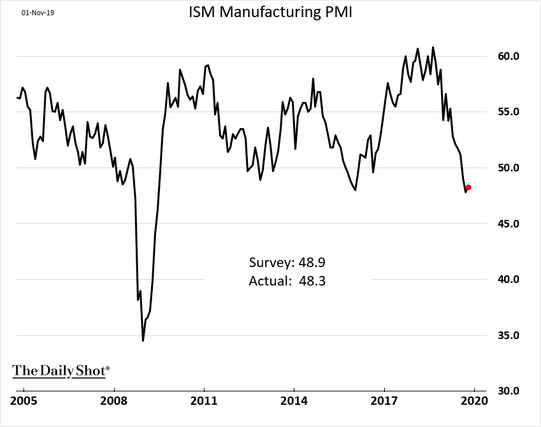
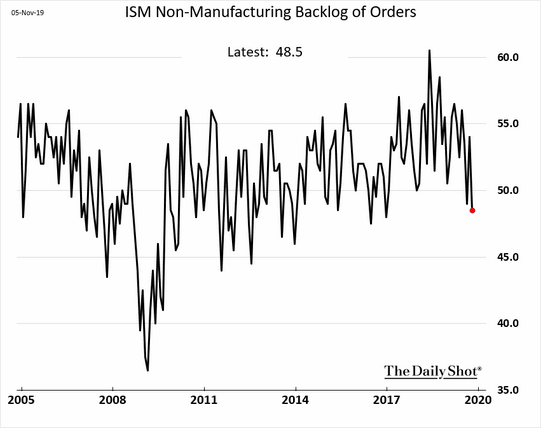
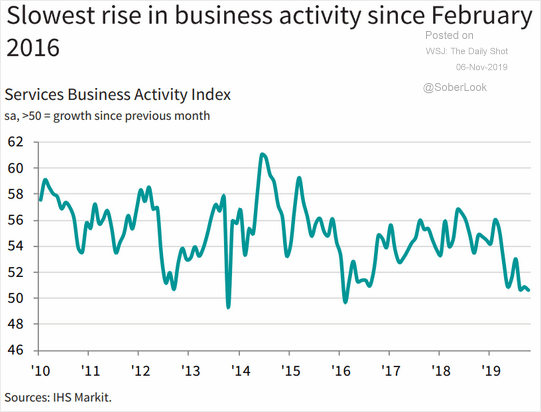
Though financial knowledge was considerably blended this month, with bearish ISM PMIs:
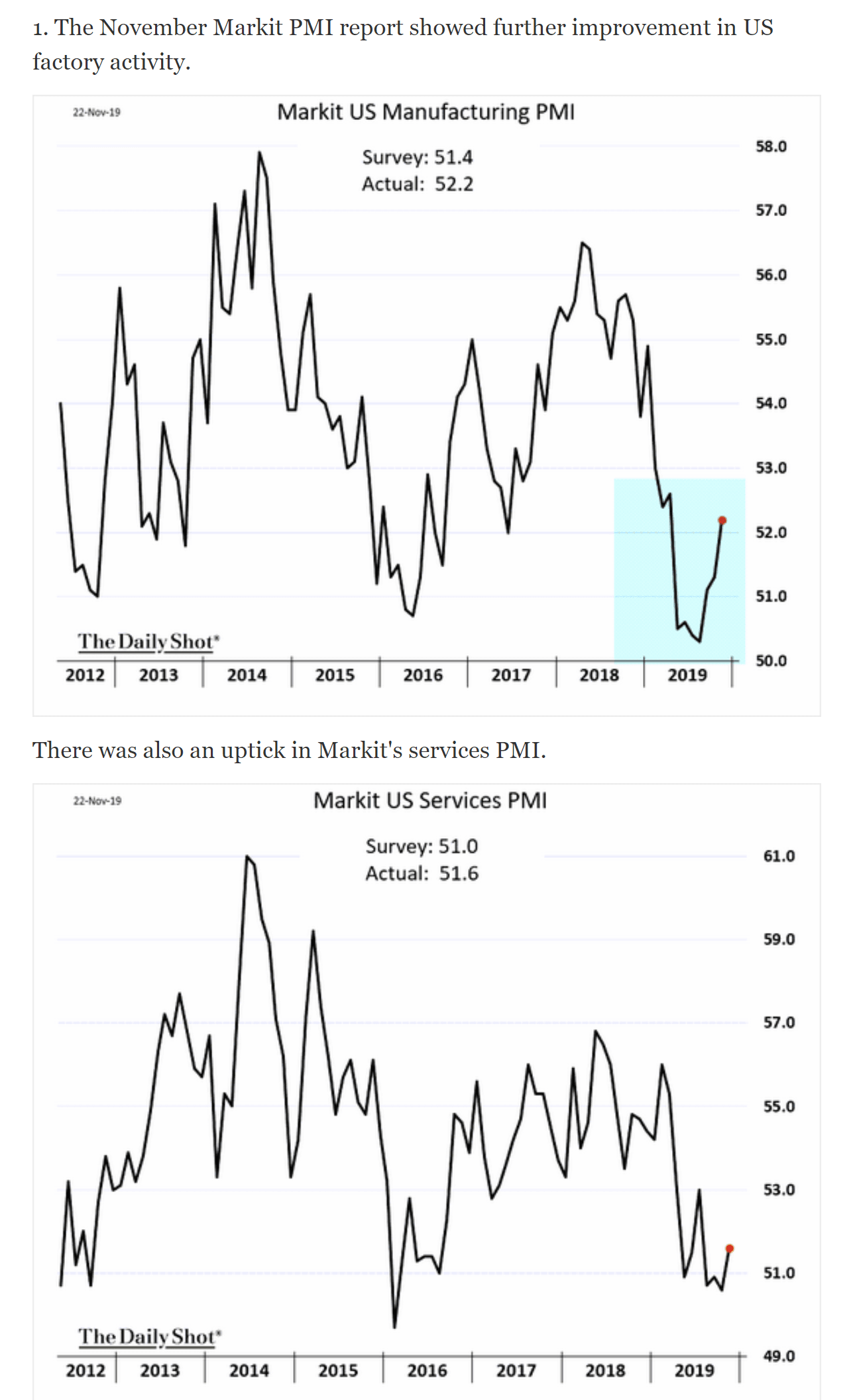
…however bullish PMIs from Markit:
…the remainder of the info was just about all unhealthy:
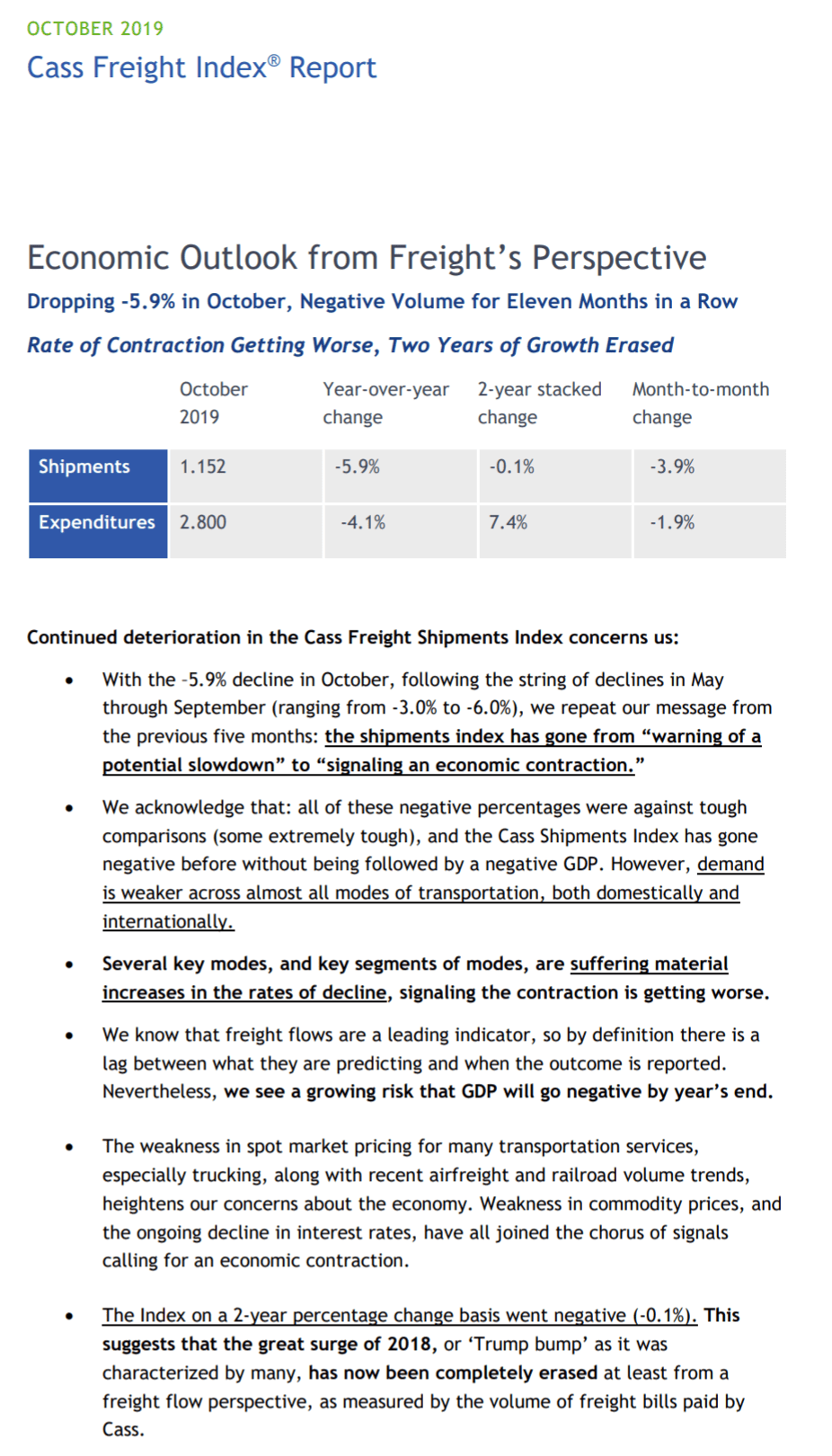
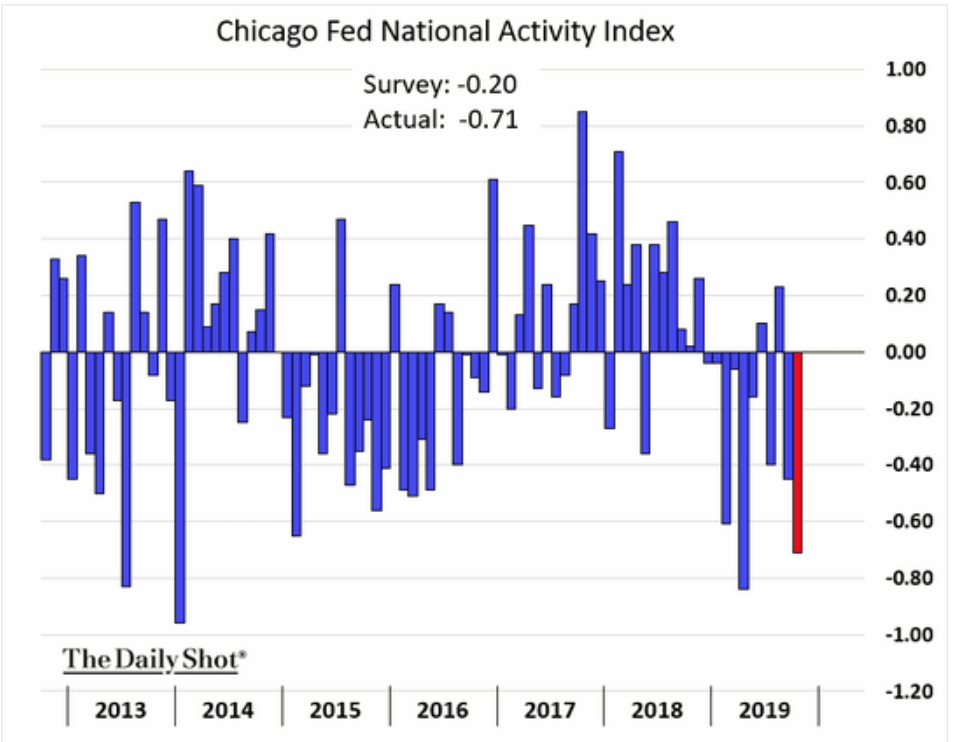
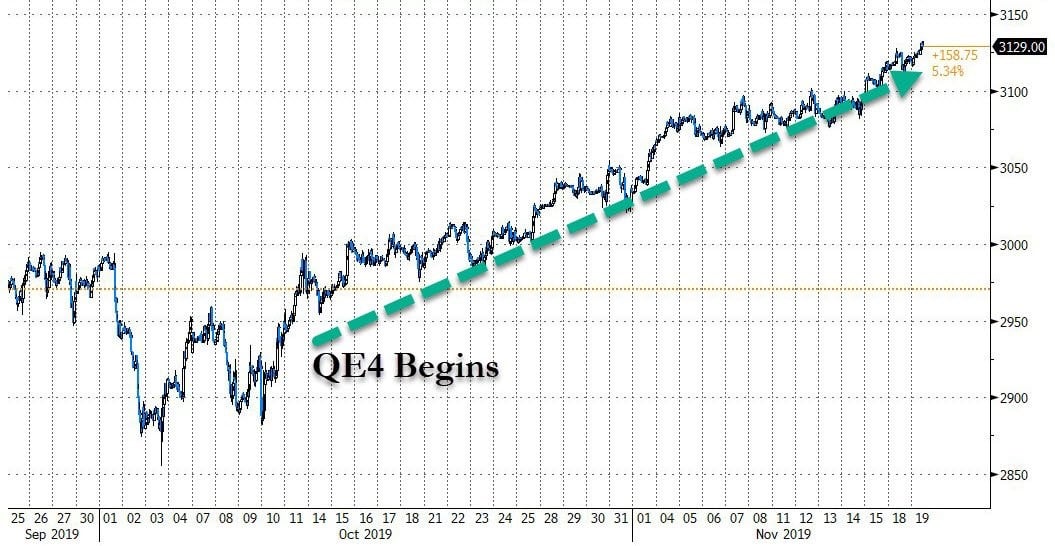
But shares maintain going up. Gee, do you suppose this might need something to do with it?
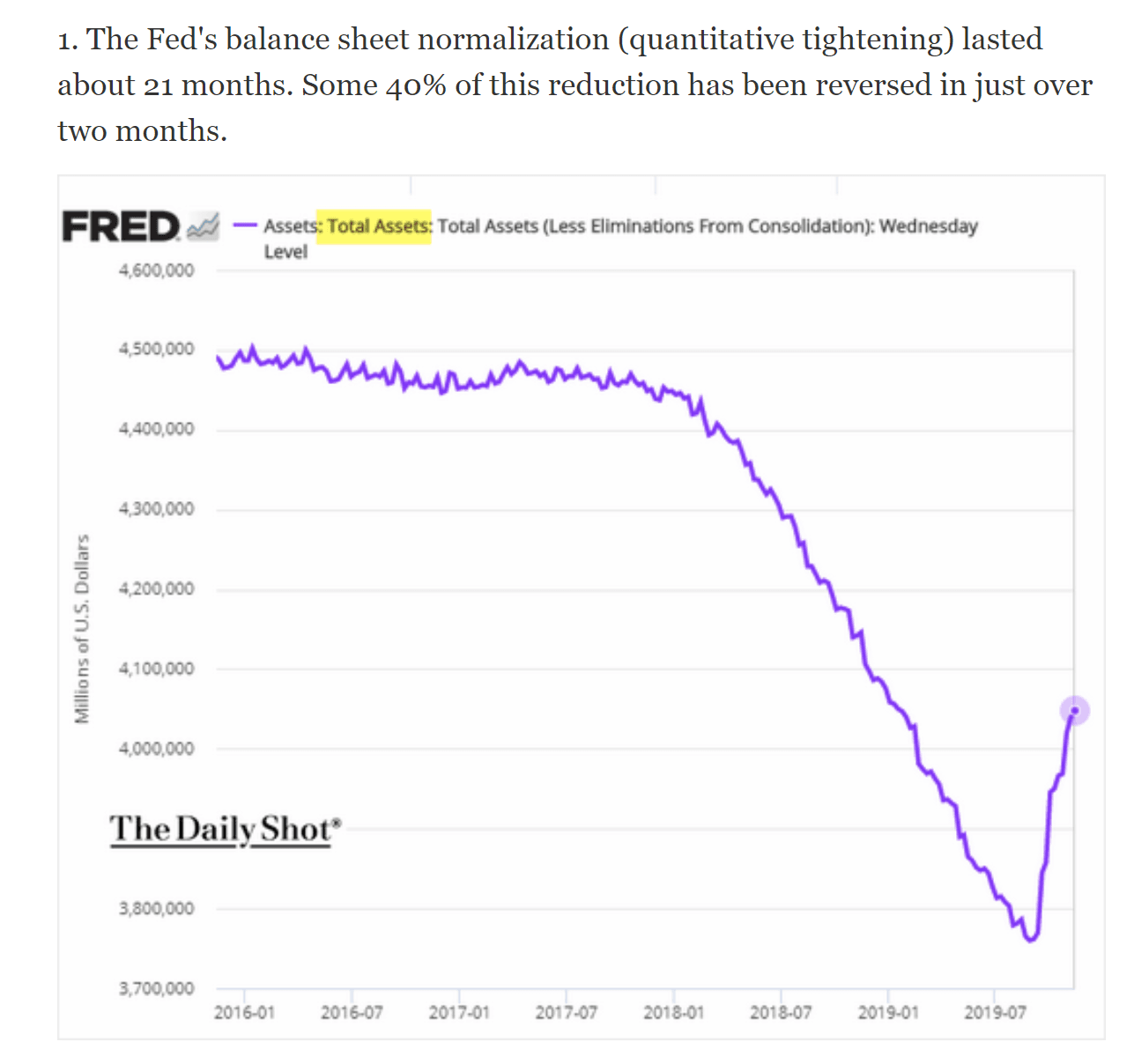
Why sure, I imagine it does (chart courtesy of @zerohedge):
One among our losers this month was our lengthy place in Westell Applied sciences Inc. (WSTL), which in November reported a horror-show of 1 / 4, with a 25% year-over-year income decline and a big GAAP loss pushed solely partly by a one-time stock write-down. About the one excellent news from Westell was that it ended the quarter with $21.7 million in money and no debt, and as burn going ahead ought to be “only” round $1.2 million/quarter, the corporate nonetheless has no less than 18 quarters of money runway to return to break-even (it’s projecting to take action in 5), and clearly many greater than that if it may minimize the burn alongside the way in which. Following the report and projection of break-even being reached in 5 quarters, the CEO stepped up and purchased inventory within the open market, so if nothing else, no less than the man’s placing his cash the place his mouth is; the corporate concurrently posted a brand new investor presentation. We proceed to personal this firm as a result of it’s a $30 million/12 months, 38% gross margin enterprise with over $1.25/share in money but it at the moment sells for simply 1.04/share. Assuming 15.eight million shares, an acquisition worth (by a cost-eliminating strategic purchaser) of simply zero.5x income would (on an EV foundation) be round $2.20/share. Stopping such an acquisition is that Westell suffers from a twin share class, with voting management held by moronic descendants of the founder who refuse to promote firm regardless of the inventory’s horrible descent. Nonetheless, I’m hopeful that somebody will knock sufficient sense into their small brains to encourage them to salvage what’s left right here, and thus stroll away with no less than one thing from what they’ve squandered. In the event that they try this it ought to be no less than a double from right here, and certain extra. In different phrases, it’s too low-cost to promote however the board of administrators is just too incompetent to get me to purchase extra.
In distinction, our greatest performer this 12 months by far has been Communications Programs, Inc. (ticker: JCS), which we collected over the summer time at a median worth of $three.05/share and which closed November at $7.79. (We barely diminished the place in late-November within the $7.90s as a result of worth surge.) JCS is an IOT (“Internet of Things”) and web connectivity & providers firm (the corporate’s a number of divisions are greatest defined by the slide presentation from its annual assembly and this terrific Looking for Alpha article), which in October reported implausible Q3 earnings of .19/share with a 42% gross margin and $2.20/share in internet money. JCS is now making an annualized .68/share (based mostly on the primary 9 months of the 12 months, in order to not overemphasize one nice quarter), nonetheless we should always tax-adjust that to .54 because it’s been minimizing taxes by using its NOL carryforwards. A 14x a number of on that plus the money plus a $three million valuation on $15 million of NOLs would worth the inventory at round $10/share. Moreover, the corporate is in contract to promote its headquarters constructing for $10 million; if we assume that closes, it could generate >$1/share in extra money (though we’d have to scale back earnings by round .06/share as presumably it could then must lease a facility).
We proceed to personal Aviat Networks, Inc. (ticker: AVNW), a designer and producer of point-to-point microwave programs for telecom firms (right here’s an ideal Looking for Alpha article describing the corporate), which in November reported a strong FY 2020 Q1. Though income was down barely year-over-year there have been vital enhancements in each working earnings and gross margin and the corporate’s steering promised related enhancements for the total 12 months. Moreover, Aviat has over $400 million of U.S. NOLs, $eight million of U.S. tax credit score carryforwards, $212 million of overseas NOLs and $2 million of overseas tax credit score carryforwards; thus its earnings will probably be tax-free for a few years, so GAAP EBITDA much less capex basically equals “earnings.” Valuation-wise, if we assume $14 million in FY 2020 adjusted EBITDA (first-half steering is $7.5 million) and take away $1.7 million in inventory comp and $6.1 million in capex we get $6.2 million in earnings multiplied by, say, 14 = roughly $87 million; if we then add in roughly $32 million of anticipated year-end internet money we get $119 million, and if we divide that by 5.four million shares we get an earnings-based valuation of round $22/share. Alternatively, if we take a look at Aviat as a buyout candidate its closest pure-play competitor, Ceragon (CRNT) sells at an EV of roughly zero.5x income, which for AVNW (assuming $240 million in 2020 income) could be zero.5 x $240 million = $120 million + $32 million anticipated year-end internet money = $152 million. If we worth Aviat’s $400+ million in NOLs at a modest $10 million (resulting from change-in-control diminution of their worth), the corporate could be price $162 million divided by 5.four million shares = $30/share.
We proceed to personal a small place within the PowerShares DB Agriculture ETF (ticker: DBA), as agricultural merchandise stay essentially the most beaten-down sector I can discover that isn’t a “buggy whip” (one thing on the way in which to obsolescence) or cyclical from a requirement standpoint. Maybe “Phase 1” of Trump’s China commerce deal plus latest harsh climate within the farm belt will lastly have the ability to transfer it greater.
And now for the brief positions…
We proceed to carry a brief place within the Vanguard Whole Worldwide Bond ETF (ticker: BNDX), comprised of dollar-hedged non-US funding grade debt (over 80% authorities) with a ridiculously low “SEC yield” of zero.5% at a median efficient maturity of 9.9 years. With Euro space core inflation at 1.three% and—as a result of ECB’s money-printing finally headed a lot greater—I imagine this ETF is a good way to brief what would be the largest asset bubble in historical past. Presently the web borrow price for BNDX gives us with a constructive rebate of zero.5% a 12 months and I feel it’s a terrific place to take a seat and watch for the inevitable denouement of this madness.
Equally, we stay brief the long-term U.S. Treasury bond ETF (TLT), as a result of as our federal funds deficit escalates (it’s now round $1 trillion a 12 months), I feel the market will elevate long-term charges due to the Fed’s reticence to take action. The web price of keep on this place is barely round 1% a 12 months, and after I see the money-printing craziness* starting once more, I contemplate that to be cheaply purchased peace of thoughts. Should you’re unfamiliar with the subject, learn up on the madness misleadingly known as Trendy Financial Concept, as a result of it’s taking place proper now.
*The short-lived period of internet “quantitative tightening” among the many large three central banks (the Fed, ECB and BOJ) is over. The Fed’s steadiness sheet contraction stopped in August and >$60 billion/month of Treasury shopping for resumed in September (allegedly solely to satisfy short-term liquidity wants—a nonsensical “explanation” for debt monetization that allows D.C.’s profligate spending), whereas the ECB resumed €20 billion/month in QE and the BOJ continues printing.
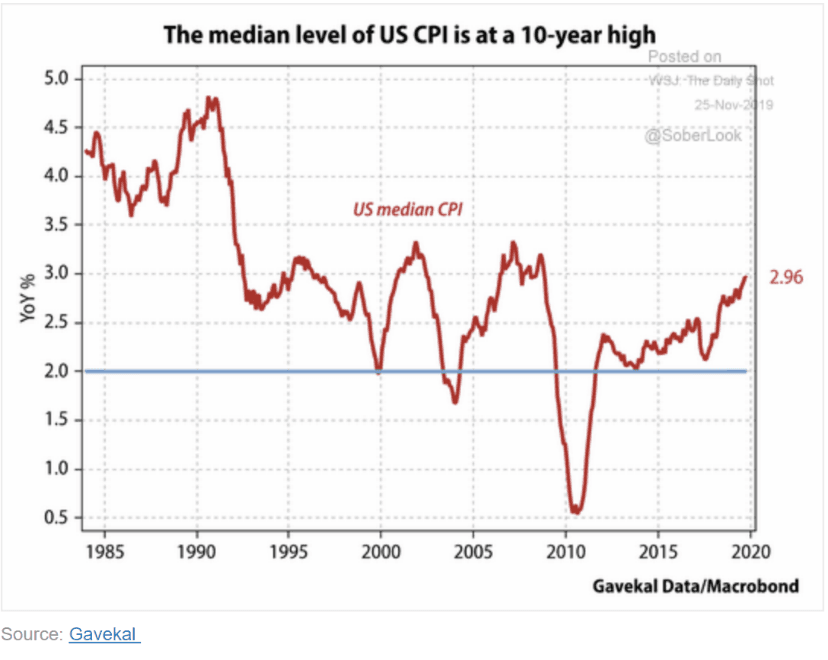
And in the meantime, with the 30-year Treasury bond yielding simply 2.2%, inflation is already right here:
We proceed (since late 2012) to carry a brief place within the Japanese yen through the Proshares UltraShort Yen ETF (ticker: YCS) as Japan (regardless of having considerably tapered its QE) continues to print over three% of its financial base per 12 months after quadrupling that base since early 2013, and is now eyeing yet one more “fiscal stimulus”! In 2018 the BOJ purchased roughly 67% of JGB issuance and in 2019 it anticipates shopping for 70%! In reality, the BOJ’s steadiness sheet is now bigger than all the Japanese economic system…
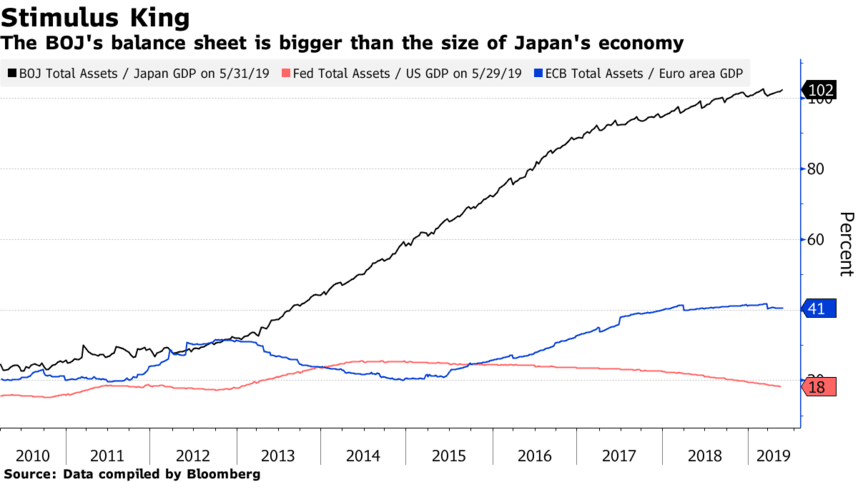
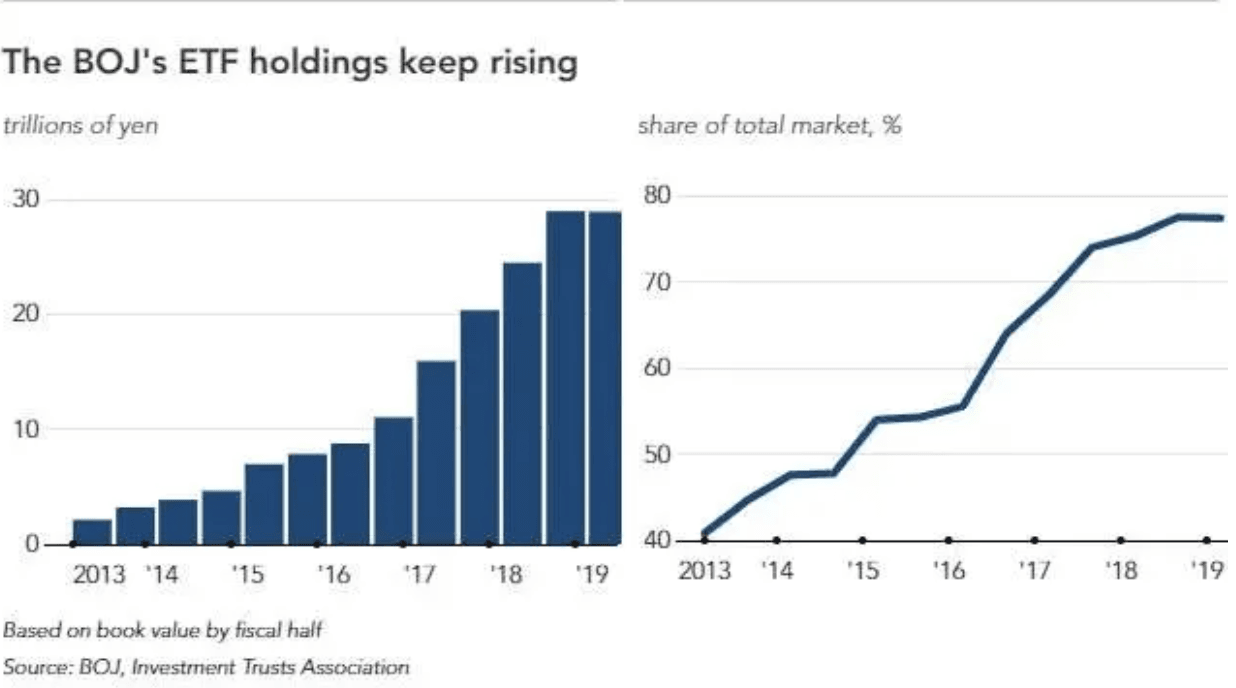
…because it owns almost 45% of Japan’s debt and almost 80% (!) of its ETFs:
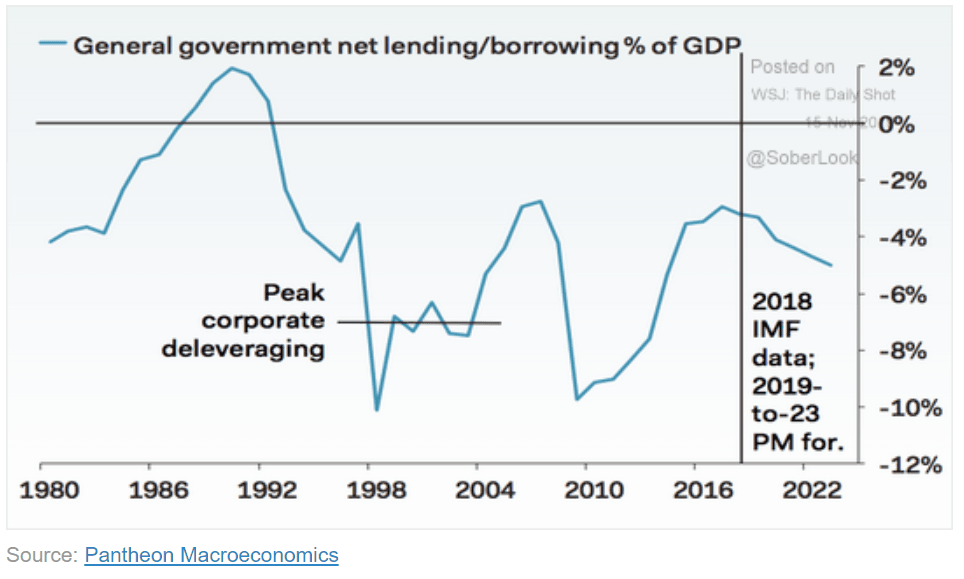
Simply the curiosity on Japan’s debt consumes eight.9% of its 2019 funds even supposing it pays a blended charge of lower than 1%. What occurs when Japan will get the two% inflation it’s on the lookout for and people charges common, say, three%? Curiosity on the debt alone would devour almost 27% of the funds and Japan must default! However on the way in which to that three% charge the BOJ will attempt to cap these charges by printing more and more bigger quantities of cash to purchase extra of that debt, thereby sending the yen into its loss of life spiral. And in the meantime, that funds deficit is predicted to worsen…
After we first entered this place USD/JPY was round 79; it’s at the moment within the 109s and long-term I feel it’s headed lots greater—finally again to the 250s of the 1980s or even perhaps the 300s of the ‘70s earlier than a default and reset happen.
We additionally maintain proceed to carry brief positions in Netflix (NFLX) resulting from its egregious valuation throughout the context of horrible money burn and growing competitors (significantly from Disney), Sq. (SQ) resulting from its egregious valuation and a stock-dumping CEO who so effusively praises (and allows) Elon Musk that I believe he’s equally untrustworthy (and certainly in June the corporate fired its auditor), Carvana (CVNA) resulting from a laughable enterprise mannequin with escalating losses, a founder with a sketchy previous and insiders who dump inventory steadily, Wayfair (W), an egregiously unhealthy on-line furnishings enterprise with yet one more group of insider stock-dumpers, Invitae (NVTA), a non-proprietary, money-losing genetic testing firm displaying unfavorable scale and Roku (ROKU), an absurdly valued (nearly 20x income, with growing losses) firm on the way in which to technical obsolescence (new Good TVs don’t want its product) with tons of insider promoting.
Thanks and regards,
Mark Spiegel
source https://jobsearchtips.net/stanphyl-brief-netflix-resulting-from-its-egregious-valuation/


No comments:
Post a Comment