Credit card financial obligation often experiences higher charge-off levels than the majority of loan items, and those can spike during a recession.

All banks are bracing for heavy loan losses as a result of the economic closed down brought on by the coronavirus pandemic One type of loan category that always comes with a larger loss rate– even under typical economic conditions– is credit card debt. For example, national charge card charge-offs (financial obligation not likely to be recuperated) in 2019 were 3.7%. It might seem like a little number, however it’s huge when you think about that many banks were reporting charge-off rates well below 1%up till just recently.
60%at the end of 2019, and the banking giant has its own credit card department. Due to the fact that credit card write-offs and delinquency rates often get even worse throughout a recession or slump, let’s see how some of the biggest credit card companies in terms of how essential credit card debt is to their general health are holding up in these precarious times.
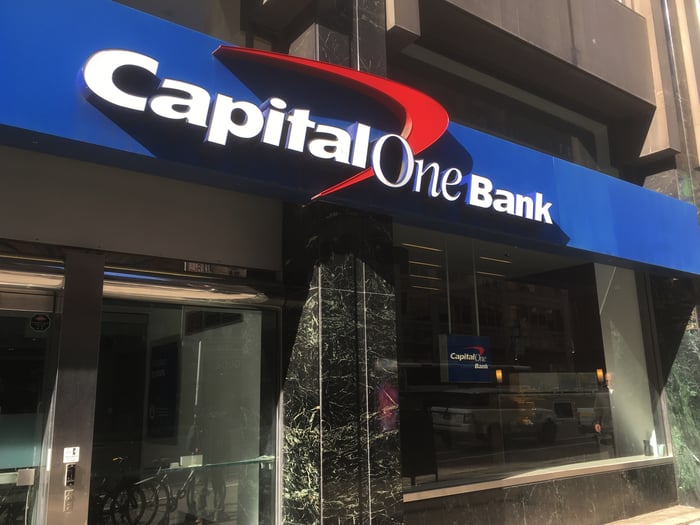
Image Source: Getty
Getting ready for losses
American Express was the only one of these business to report a favorable profit in the very first quarter of the year, and that revenue decreased by 76%from the first quarter of2019 Discover reported a net loss of $61 million in the first quarter, while Capital One took a bottom line of $1.3 billion. Revenues were hindered after all 3 business considerably increased the amount of money being set aside to cover future possible losses, otherwise called the credit arrangement.
| Credit Arrangement Q1 (billions) | Boost (connected quarter) | Total Assets (billions) | |
| Capital One | $ 5.4 | 198% | $397 |
| American Express | $ 2.6 | 156% | $186 |
| Discover | $ 1.8 | 116% | $113 |
There are a few interesting takeaways from the provisions. American Express likely carried out much better since less of its total portfolio is composed of charge card. Majority of its total income originates from discount rate profits– costs credited merchants when card members use their American Express cards to buy goods and services. Now, discount profits is down substantially in the quarter, however you do not need to reserve versus it.
Another fascinating takeaway is that the percentage increase in the credit arrangement of these companies was not as high as some of the larger, more standard banks like Bank of America ( NYSE: BAC), which increased its provision by more than 400%from the connected quarter.
That might be due to the fact that the credit card companies currently set aside more overall reserves. You would believe that companies such as Capital One and Discover, with heavy credit card loan portfolios, might see higher portion increases in their credit provision, provided the nature of their company.
Decline in costs
Another big problem injuring these business is a decline in general costs. A credit card is a type of revolving debt, so unlike an installation loan, customers do not receive a lump amount of money before investing it. Rather, they spend, or borrow, the cash initially and pay it back later on. Less investing effectively means less borrowing, along with less interest payments and deal costs.
Just Recently, the U.S. Commerce Department said customer costs dropped 7.5%in March, and a similar pattern is playing out in April. American Express exposed in its investor discussion that proprietary billings– costs on American Express cards released by the company– is down about 45%on an annualized basis in April, although it is revealing indications of supporting.

Image Source: American Express
Discover is seeing the same thing play out. Fifty-one percent of the business’s sales in 2019 were made in the travel (8%), restaurants (8%), and retail (35%) markets.

Image Source: Discover
Capital and liquidity
With heavy losses expected in the 2nd quarter and the rest of the year still uncertain, all 3 business made sure to highlight that they got in the pandemic with strong capital positions.
All three companies are also preparing to cut expenditures to reinforce liquidity even more.
Better positioned than 2008
Capital One, American Express, and Discover also said they felt much better about total credit quality than they did heading into the Great Recession in2008 Fairbank stated in general the U.S. consumer is in far better shape because consumer financial obligation levels are lower on a per capita basis, while lower interest rates make debt payments easier, and individuals save more now than they used to. Hochschild stated while 26%of Discover’s credit card portfolio at the end of 2007 had a FICO rating of below 660, that number was just 19%at the end of2019 American Express CFO Jeffrey Campbell stated 88%of U.S. customer and small organisation consumers who enrolled in the company’s customer pandemic relief program are prime and super-prime card members.
Bram Berkowitz has no position in any of the stocks mentioned. The Motley Fool has no position in any of the stocks mentioned. The Motley Fool has a disclosure policy.
“>< period data-content ="
Bram Berkowitz has no position in any of the stocks mentioned.
The Motley Fool has no position in any of the stocks mentioned. The Motley Fool has a disclosure policy
” >
.
%.
source https://jobsearchtips.net/how-the-major-credit-card-companies-are-faring-throughout-coronavirus/


No comments:
Post a Comment